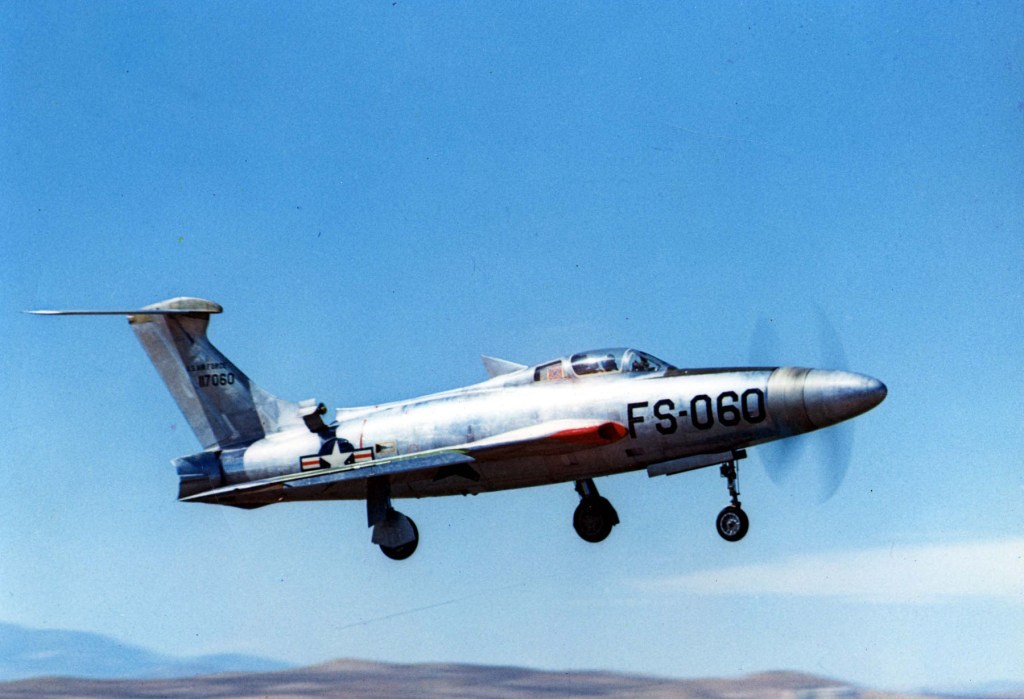
The turboprop plane labelled as “a monstrosity,” and “a mechanical nightmare,” that would make the crew physically sick.
In search of a carrier-based aircraft that could take off without the assistance of a catapult, an experimental propeller-driven aircraft that created a continuous stream of sonic booms, also known as the XF-84H, was born. Little did they know, ground crews and the surrounding areas would find themselves hearing ear-splitting frequencies, vomiting, and in one case, a seizure.
The Republic Aviation Corporation, who also produced the P-47 Thunderbolt and the F-105 Thunderchief, took on the joint Air Force-Navy project around the 1950s. It was intended to create one Navy prototype along side two for the Air Force, however, the Navy must have dropped the program early on because only two Air Force prototypes were created. No analogous Navy designation was ever received for the creation of the aircraft either.

Restoration staff taking the last surviving prototype to the 4th building of the Air Force Museum in 2015. Photo courtesy of the National Museum of the United States Air Force.
Trying to create a high-performance propeller was where the unusual properties of this aircraft began. The propellers measured in with a 12-foot diameter and had a three-bladed airscrew that were extremely wide and square-tipped blades. At the designed constant rotation speed of 3,000rpm, this made the outer 12 to 18 inches of the blade supersonic. Not to mention, the tips were moving at Mach 1.18, in other words, around 905 miles per hour and faster than the speed of sound. This produced an ear-piercing sonic booms and was reportedly heard up to 25 miles away, making it the loudest aircraft in history. Groundcrew and maintenance unofficially named the XF-84H ‘Thunderscreech’ after this iconic howl.
Engine failures were the leading cause of failed test flights of the XF-84H with 10 out of 11 ending in forced landings with one of the prototypes. The propellors created significant vibrations that ultimately led to these forced landings and nerved pilots while in flight. This along with the torque force, a rotating force making the aircraft body to rotate left while the prop turned to the right, was so powerful that multiple modifications were made, adding to the unique qualities of the Thunderscreech.

Inside the cockpit of the XF-84H. Photos Courtesy of the National Museum of the United States Air Force.
Adding to the list of problems, crews working on this project found it challenging to work with. The constant and visible sonic boom from the propellor knocked down any person that was near it, even when the engine was on idle. With a start up time of 30 minutes, these crews had their work cut out for them. A crew chief in a near by plane reported being incapacitated for 30 minutes while the XF-84H was just taxing. This was not an uncommon story being heard from all parties involved. Many stories reported include ground crews getting nauseous or headaches when around the plane. Other reported symptoms were claims of people fainting, becoming slightly deaf, and supposedly soiling themself. A seizure was even induced after an engineer got too close to the prop.

The Thunderscreech now on display in the Research and Development Gallery. Photo Courtesy of the National Museum of the United States Air Force.
With the cons outweighing the pros, the program was doomed to a short lifespan with the USAF cancelling the program in September of 1956. Thus leading the program to only have 5 or 6 years of operation. Today, one prototype is still in existence at the National Museum of the United States Air Force in Dayton, Ohio. The other is believed to have been scraped and possibly repurposed in the development of the Douglas A2D.
 Written by Samantha Yost

 Yost Photography